
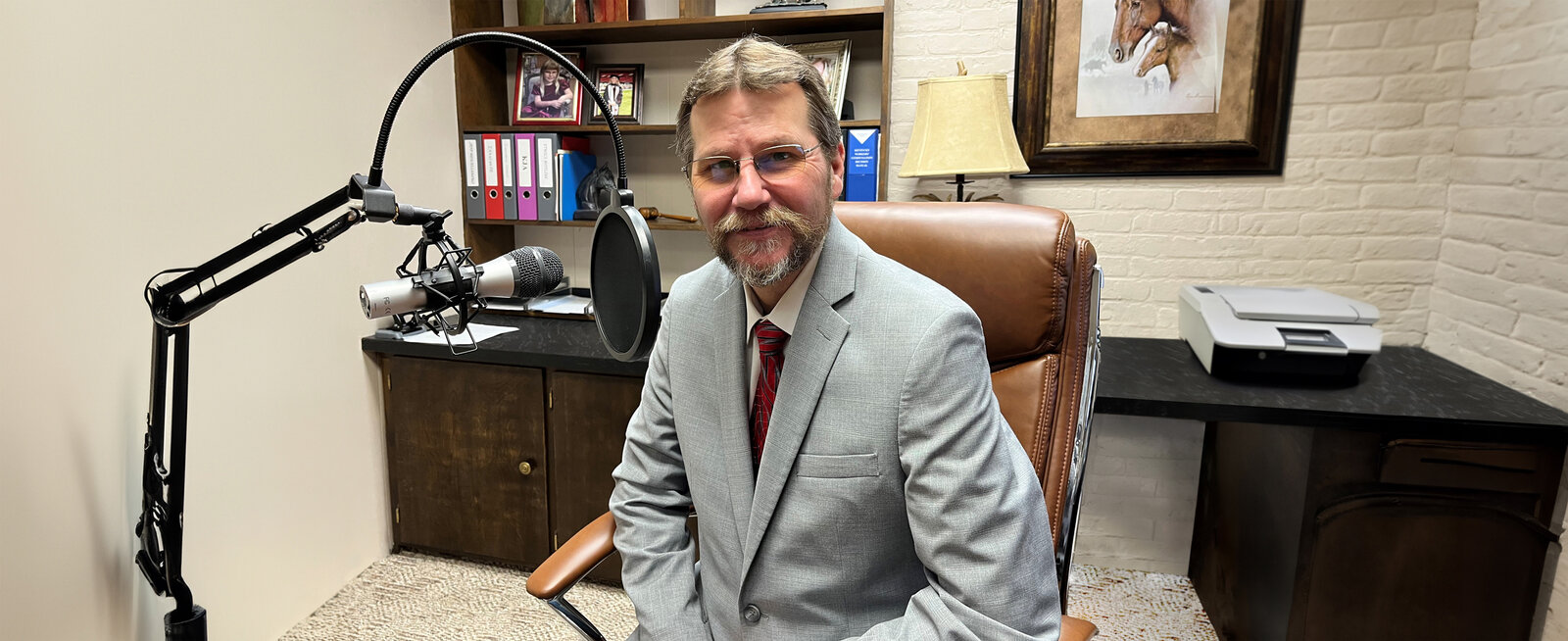

Episode 121: In today’s episode, Calloway County workers’ comp attorney Jeff Roberts explains the various benefits available under worker’s compensation. If you’ve suffered a workplace injury, this discussion will provide you with information about what’s covered and what kinds of items you can recover.
In Kentucky, you can receive benefits is you have a work-related injury, if you’ve developed a cumulative trauma injury, hearing loss or an occupational disease, as part of your work environment.
You don’t necessarily have to have suffered your injury in Kentucky to qualify for Kentucky workers’ comp benefits. If your employer has substantial ties to Kentucky, such as a headquarters, and you work outside of the state, you could still file for Kentucky benefits, which often are better than those of other states. It’s not based on where you live.

Cumulative Trauma Injuries
These repetitive motion injuries, as discussed in Episode 31, occur over time. The injury is not necessarily caused by a single incident. Activities over a long period of time, such has lifting items over your shoulder, can break down the shoulder, over time. If you type all day, carpal tunnel, can result. This is also a type of cumulative trauma that qualifies for benefits available under worker’s compensation.
Jeff advises you to be on the lookout when your doctor diagnoses you with arthritis, or simply getting older. Arthritis can be caused by repetitive motion. It may be proven that your job-related tasks actually caused the arthritis. The same goes for walking all day on concrete over the years. This might be the cause for arthritis in your knee.
You need to take time to describe the type of work you perform and those activities. Ask your doctor if those activities could be a cause of your pain and/or injury. If so, you may qualify for workers’ comp benefits.
Pre-Existing Conditions Aggravated by Work Activity
Degenerative disc disease in the lower back could also be work-related. While most adults will eventually suffer this to some extent, did your job accelerate or aggravate the situation? A pre-existing condition that was made worse by a workplace injury can also qualify you for worker’s compensation benefits. A doctor will need to specify that the condition was “dormant” until the workplace injury made it worse.
Hearing Loss Due to Work
In Kentucky, hearing loss is treated a little differently. Jeff worked at the Briggs & Stratton plant during college. It was a very loud work environment. Benefits for permanent disability are based on an impairment rating. Your hearing loss must be at an 8% impairment rating, or higher, for you to qualify for benefits available under workers’ compensation. However, even without an overall 8% rating, you could still get medical expenses covered. Jeff explains how this enabled a client to receive a cochlear implant.
Occupational Disease Cause by Work
People in this area usually think about black lung for coal miners. However, there are other types of diseases, such as respiratory diseases and cancer, that could be caused by the workplace. Heavy metal poisoning is another type of case that could qualify for workers’ comp.
COVID is another potential, occupational disease. It’s a communicable disease. The courts are still grappling with this. Jeff explains that COVID could be considered either an occupational disease or an occupational injury. The process of proving COVID was caught while you were at work, can be difficult.
Asbestos-related diseases, such as asbestosis or mesothelioma, can potentially be proven to be work-related, and thus qualify for workers’ comp.
Jeff is currently involved in a case before the Kentucky Supreme Court involving a COVID-related claim for workers’ compensation benefits. He is arguing that the client’s COVID should be treated as an occupational injury.
Types of Workers’ Compensation Benefits in Kentucky
Medical Expenses: This is a very common question Jeff hears from injured workers. The medical expenses for a workplace injury are covered by workers’ comp. There are no deductibles or copays. This also applies to medicine and prescriptions related to treating the work injury. Treatment can be covered for 15 years or longer. Some injuries automatically qualify for lifetime coverage.
Reimbursement for the mileage you incur when seeking medical treatment is also covered. You may need to visit a specialist in a different city or state. That mileage, and some related expenses can be reimbursed. Remember, you have to submit your reimbursement form within 60 days of incurring the expense. You’ll use Form 114, which Jeff discussed in a previous episode.
Temporary Total Disability Benefits (TTD): These are paid to you, while you’re off work, due to doctor’s orders. Jeff explains the amount is equal to 66 2/3% of your average weekly wage. This calculation is often done incorrectly, so let your attorney review it. There is a cap on the amount. Additionally, if your employer is aware you have a side-job, your income for that second job can be included in the calculation of your average weekly wage. Listen to Episode 77 for a detailed discussion about how your benefits are calculated.
You must be off-work 7 days to qualify for TTD benefits. Interestingly, you have to be off of work for 15 days, to get paid for the first 7 days of missed work.
Temporary total disability payments will continue until your doctor determines you’ve reached maximum medical improvement (MMI), or you reach a level of improvement that allows you to return to work. If you’ve reached MMI, but still cannot return to work, your condition will now need to be classified as a permanent disability.
If you return to work, under a light-duty restriction, and your employer has fewer hours available for your light-duty work, workers’ comp will make up the gap in your after-tax earnings. Jeff refers to this a temporary partial disability.
Permanent Partial Disability Benefits: If you’ve suffered a workplace injury that enables you to return to work, but with a permanent impairment rating, you can still receive benefits. The impairment rating will determine the amount of benefits you will receive. It also takes into consideration whether you can return to the same job you had before the injury. The amount of money you’ll earn upon returning to work, your age, your education and your work history will impact the amount of benefits you’ll receive. These benefits are limited to specific amount of time of 425-520 weeks, depending upon the severity of your impairment rating.
Jeff described how he used to operate a punch press and later worked in die casting, while in college. If a worker loses a finger in a press or some other type of accident, he/she may be able to return to work, but they’ll receive permanent partial disability benefits, based on the various factors he described.
Permanent Total Disability Benefits: These will continue until you reach age 70 or for 4 years, whichever is longer. You’ll have an impairment rating, but there are other factors. You’ll receive 66 2/3rds percent of your average weekly wage, paid until age 70 or for 4 years.
Vocational Rehabilitation Benefits: If you suffer a workplace injury and cannot go back to your original field of work (or something you’ve done in the recent past), you may qualify for vocational rehab benefits. This would pay for education, or trade school and some related expenses to help you train for a different type of job. The benefits could pay for 1-2 years of retraining. Age is a factor. A judge might not grant this benefit if you’re 65, but if you’re in your 20s, 30s, 40s, or 50s, you may be able to qualify.
We hope you found this episode insightful and helpful.
Thank you for listening!
What Do Other Clients Think About Jeff?
We always encourage listeners to read the Google Reviews Jeff Roberts has received from many of his clients. A 5-Star rating and the comments are earned recognition and demonstrate Jeff’s commitment to his clients. As a solo attorney, he has more Google Reviews than some firms with multiple attorneys. Jeff shares the credit with his staff at the Roberts Law Office. Successfully representing injured clients is a team effort. It’s why Jeff likes to say his firm offers small town service with big city results.
Jeff Roberts Represents Injured Clients Throughout Kentucky
With offices located in Calloway County (Murray) and now in Christian County (Hopkinsville), Jeff has a history of representing personal injury clients, workers’ compensation clients and social security disability clients across the state. He’s represented clients from Paducah, Bowling Green, Louisville, Covington, Whitesville and many other Kentucky locations. He’s not just a Western Kentucky injury attorney.
Is It Time to Speak with an Attorney about Your Workplace Injury Claim?
The office phone number is (270) 753-0053 or toll free at 800-844-5108. For more information, visit www.JeffRobertsLaw.com. This podcast is meant to provide information and is not legal advice. Jeff’s principal office is located at 509 Main Street, Murray, Kentucky. Co-host Jim Ray is a non-attorney spokesperson. This is an advertisement.