
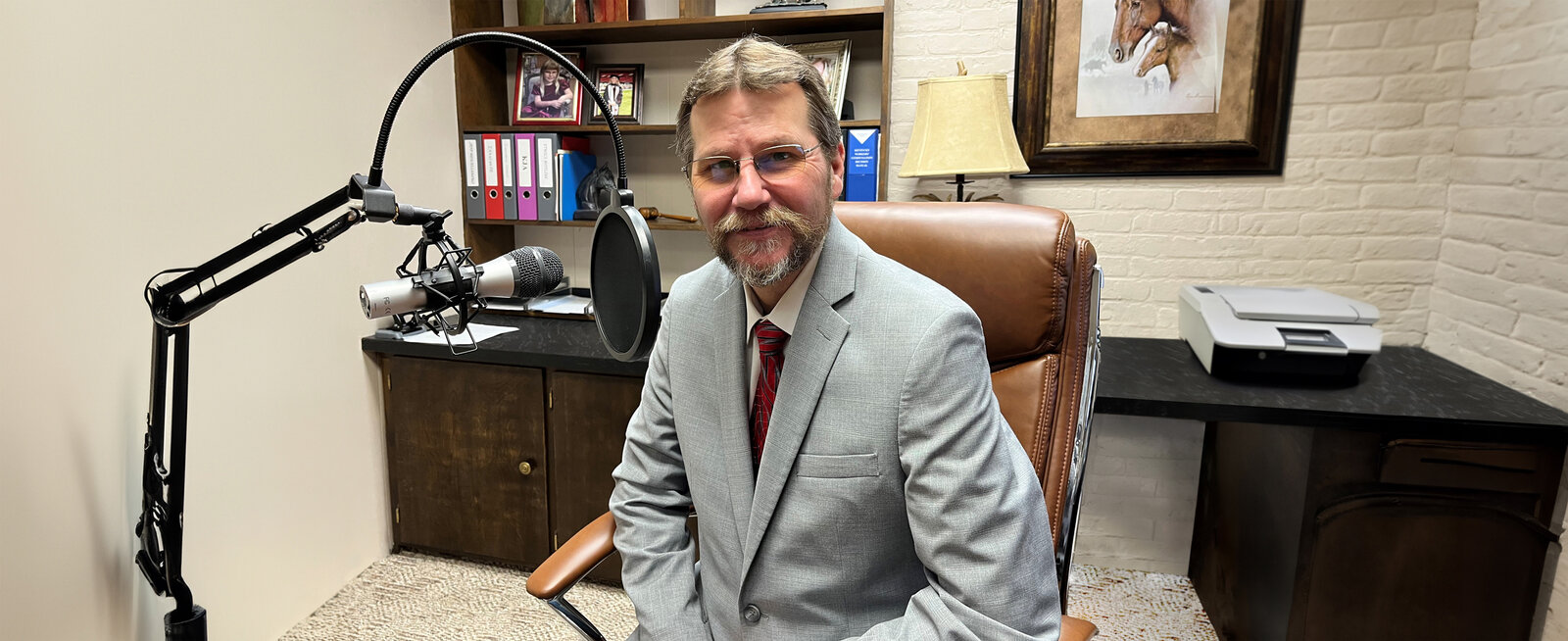

Episode 100: Calloway County social security disability attorney Jeff Roberts discusses issues related to testifying at your social security disability hearing. Jeff has over 32 years of experience representing clients in a number of states. He also offers his 4 Golden Rules of testifying before the social security administrative law judge handling your claim.

Social Security Disability in General Terms
The Social Security Administration oversees 2 separate disability programs. Social Security Disability Insurance (SSDI) and Supplemental Security Income (SSI) both have the same determination when it comes to whether the individual qualifies for disability, from a medical standpoint. However, there are non-disability factors. SSI is a needs-based program which considers the household income in determining whether the person qualifies to receive SSI benefits. SSDI is based on what you’ve paid into the social security system over your work history. There is a period of time that must have been met that would qualify you for SSDI benefits. This is referred to as the insured status requirement. Your qualification generally lasts up to 5 years after you stopped working. That doesn’t mean the benefits only last that 5 years, but rather, your ability to qualify based on the requirement.
Even though Jeff explains that social security disability insurance is related to your work history, this is different from the workers’ compensation benefits you may also be able to receive for your workplace injury.
Apply for Social Security Disability Benefits
The process is basically the same for both SSDI and SSI benefits. You’ll make your initial application. It can be done online, over the phone or in-person. The Department of Disability Services (DDS) will review your application. They will request your medical records and make the initial determination regarding whether you qualify to receive disability benefits. Statistically, you will probably be denied at the initial level.
A Request for Reconsideration can then be filed. DDS will review the information, often using a different medical professional. They will then make another determination as to your eligibility. Unfortunately, statistically, you will probably be denied at this secondary level, as well.
At this point, you can file a Request for Hearing before an administrative law judge. Your case would then be sent to a hearing office. There are different locations across the state of Kentucky and other states. For instance, if you live in Calloway, Christian or Graves County, the hearing site is located in Paducah.
An In-Person Hearing Tells the Full Story
You’ll receive a notice asking for your consent to have either a telephone, video conference or in-person hearing, regarding testifying at your social security disability hearing. Jeff strongly recommends requesting an in-person hearing before the judge.
The majority of communication between humans is non-verbal. Jeff explains that this non-verbal communication can have an impact on the judge’s perception of the extent of your injuries. While much of the determination is based on your medical records, there is still a subjective aspect to the ultimate decision. You want to ensure the judge is able to get a true sense of the extent of your condition.
When you have a telephone hearing, all of the non-verbal elements are lost. A video conference can be more effective, but the judge will only see what’s on his/her screen. This limits much of that non-verbal communication. However, when you physically enter the hearing room and sit before the judge, it’s a different story. You might say, the judge now has the opportunity to get a sense of the full story.
Jeff Can Represent Clients in All 50 States
The social security programs are federal programs. For this reason, Jeff is licensed to handle social security disability claims in all 50 states. His workers’ comp and personal injury cases are limited to Kentucky.
When Should You Get an Attorney Involved in Your Social Security Disability Claim?
In Jeff’s opinion, he advises clients to come see him after they’ve received their initial denial. There’s not much an attorney can do regarding the initial application for benefits. Again, statistically speaking, that initial applications is probably going to be denied.
However, in Episode 76, Jeff discussed the Listing of Impairments that can qualify someone to receive social security disability benefits from the initial application. These are specific conditions that are severe enough that the judge should grant the benefits. Even so, it may not be automatic. You may need to get an attorney involved to get your disability benefits approved at the reconsideration level. This can be a significant advantage when testifying at your social security disability hearing.
What Happens at Your Disability Hearing
On the day of your hearing, the judge will bring you back to the hearing room. This can often feel like a typical conference room, or room with a set of conference tables. You and your attorney will sit at one of the tables. Another person will serve as the hearing assistant to make sure the equipment used to record the hearing is working. A vocational expert will participate either in-person or via conferencing. There’s not a jury and this isn’t like a courtroom you may have seen on TV. This is considered an administrative hearing. These are closed hearings.
Most judges will let the attorney make an opening statement. The claimant will be the first to testify at the hearing. The judge will ask questions about the person’s general background. He/she will ask about the individual’s work history during the past 5 years of employment. It’s important to inform the judge of what you have difficulty doing now. This will help to show whether you could return to a previous type of job. The judge will typically ask the vocational expert if he/she needs additional information.
The judge would then begin to focus on the medical issues that could limit the person’s ability to work. The attorney normally handles this part of the hearing. He/she will present why the benefits should be granted. The judge will also ask questions of the claimant.
The 4 Golden Rules of Testifying at Your Disability Hearing
Jeff has a set of rules he reviews with his clients before the hearing. This is meant to help them to be prepared for how they will answer questions and the information they will provide. It’s important that you review these prior to testifying at your social security disability hearing.
Golden Rule #1: Make sure you hear and understand the question before you give an answer. Jeff points out that people may anticipate what’s being asked, so they jump-in before understanding what is specifically being asked. The first issue is that the audio record of the hearing will be distorted because you’re talking over the other person. The second issue is that you might incorrectly answer the question because you didn’t allow the other person to fully ask the question.
If you didn’t hear the actual question, due to some distraction, ask the judge or attorney to repeat the question. The judge might not realize you didn’t hear the actual question and you may be answering to something you thought was being asked. This can create issues during the hearing.
It’s quite possible that the judge or attorney uses a legal term that you don’t fully understand. It’s okay to ask for a clarification. You want to be able to answer the specific question, appropriately.
Golden Rule #2: Give a verbal answer. Again, the hearing is being recorded in case something needs to be reviewed on by the judge or if the case goes up on appeal. If you nod or shake your head to a question, that response won’t be preserved for the case record.
Golden Rule #3: Give a full, honest and complete answer. This is the most important rule. You have been sworn-in, so you’re required to give honest answers. However, giving full and complete answers is extremely important, as well. It’s possible that a short answer could be honest, but not accurate.
For instance, assume you have low-back injury. If the judge asks, can you vacuum? You might answer “yes.” However, the full and complete answer might be more of, “Yes, I can vacuum. However, due to the pain in my back, I have to stop and rest for 10-15 minutes after each room. This obviously takes me much longer to complete the task.”
The same issue could apply to a question of whether or not you can drive. You may need to get out of the vehicle and stretch or rest for a period of time, fairly frequently. This would affect your ability to perform that job requirement in a timely fashion.
The full and complete nature of your answer adds important context to the honest answer. The judge needs to have this context to properly evaluate your answers to questions.
Golden Rule #4: Don’t volunteer information. Jeff advises that once you’ve given an honest, full and complete answer, just be quiet. Let the judge or attorney ask the next question. If more information or a clarification is needed, they’ll ask. If you continue talking, you may open up a line of questioning that may not be expected. Your ongoing comments might not be helpful to your case. Trust your attorney to guide you through the questions.
We hope you found this episode insightful and helpful. Thank you for listening!
What Do Other Clients Think About Jeff?
We always encourage listeners to read the Google Reviews Jeff Roberts has received from many of his clients. A 5-Star rating and the comments are earned recognition and demonstrate Jeff’s commitment to his clients. As a solo attorney, he has more Google Reviews than some firms with multiple attorneys. Jeff shares the credit with his staff at the Roberts Law Office. Successfully representing injured clients is a team effort. It’s why Jeff likes to say his firm offers small town service with big city results.
Jeff Roberts Represents Injured Clients Throughout Kentucky
With offices located in Calloway County (Murray) and now in Christian County (Hopkinsville), Jeff has a history of representing personal injury clients, workers’ compensation clients and social security disability clients across the state. He’s represented clients from Paducah, Bowling Green, Louisville, Covington, Whitesville and many other Kentucky locations. He’s not just a Western Kentucky injury attorney.
Is It Time to Speak with an Attorney about Your Social Security Disability Claim?
The office phone number is (270) 753-0053 or toll free at 800-844-5108. For more information, visit www.JeffRobertsLaw.com. This podcast is meant to provide information and is not legal advice. Jeff’s principal office is located at 509 Main Street, Murray, Kentucky. Co-host Jim Ray is a non-attorney spokesperson. This is an advertisement.