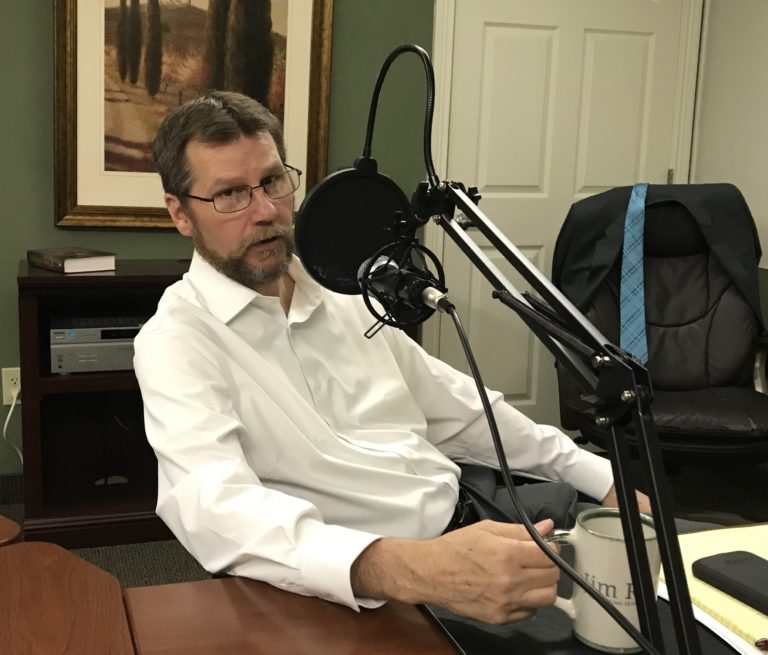
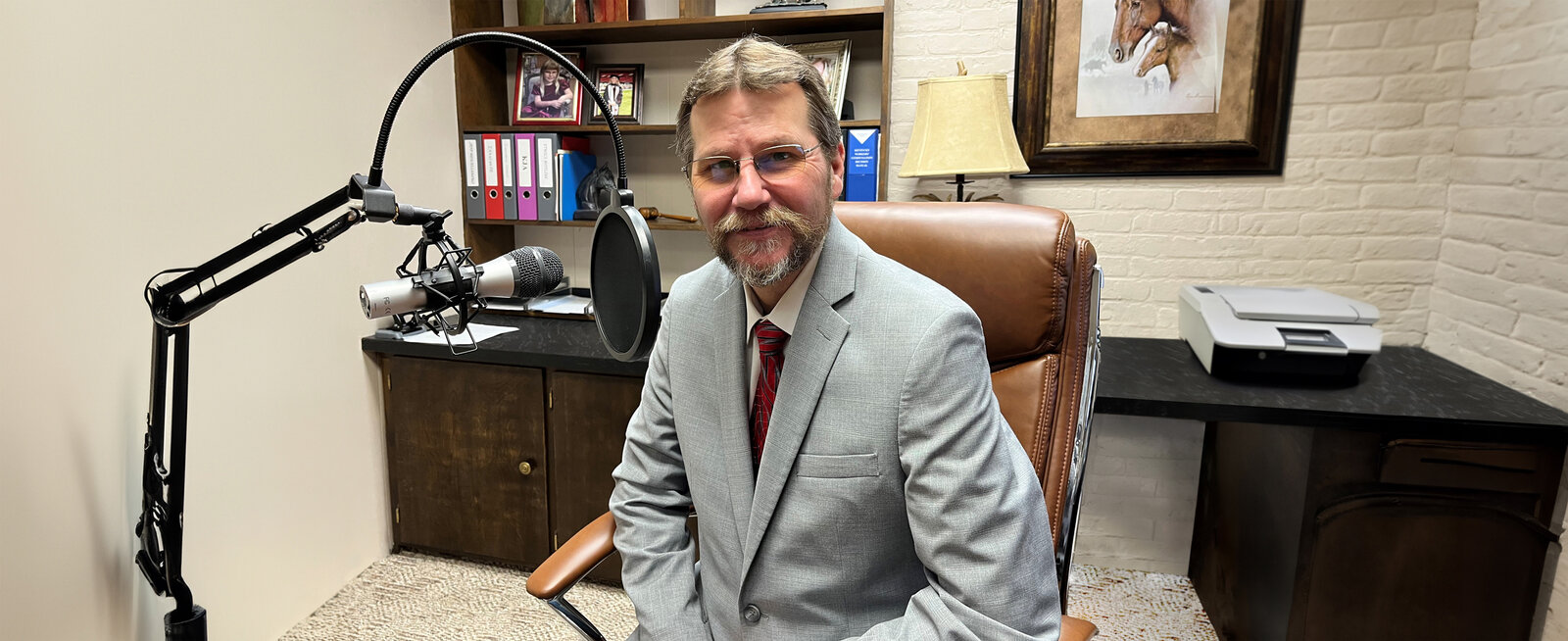
Episode 109: Calloway County injury attorney Jeff Roberts will provide a number of safe driving tips, based on almost 33 years of experience handling car wrecks, motorcycle accidents and trucking collisions. He’ll address the importance of seatbelts, child safety seats, distracted driving and more. Jeff has built his career representing injured clients, and during that time, he’s also helped families who had loved ones killed in traffic fatalities. Those can be some of the most challenging cases an attorney handles, especially given the emotional issues the family is coping with throughout the case and beyond.
Seatbelts Are a Huge Factor in Surviving a Motor Vehicle Accident
Even if you’re a very safe driver, there are situations you cannot control. If someone else crosses the center line on the road, runs a stop sign, or blows through a red light at an intersection, that negligence can have tragic consequences.
However, the decision to wear your seatbelt is something you can control. This simple step can significantly reduce the severity of the injures we might sustain, as a result of the other drivers’ negligent behavior.
Years ago, cars generally only had lap belts in the front seat. We hadn’t significantly grasped the positive impact seatbelts have in car wrecks. Fortunately, the use of seatbelts has significantly increased over the years. Jeff recalls a 2024 statistic indicating the regular use of seatbelts in the US has risen to 91.2% of the population. The statistics go onto indicate 49% of deaths in motor vehicle accidents are attributed to people not wearing seatbelts. Interestingly, that means roughly 9% of people weren’t wearing seatbelts at the time of the collision and nearly half of that population died, as a result. Seatbelts statistically make a play an extremely important roll in the reduction of traffic fatalities.
What about the Fear of Getting Trapped in the Car because of the Seatbelt?
Jeff has spoken with people who use this excuse as a justification to not wear a seatbelt. He points out that there is a very, very minimal chance this could occur, so hedging against that possibility doesn’t make a lot of sense given the overall data related to the benefit of wearing seatbelts.
Even if there are reported instances of people being trapped inside of the car, it most-likely was due to something other than the seatbelt.
Can Not Wearing a Seatbelt Negatively Affect Your Accident Claim?
In Episode 96, Jeff explained that Kentucky is a pure comparative fault state. This means some of the fault for the injuries could be assigned to you, even if the collision was not your fault. If you choose not to wear your seatbelt, an expert may be able to show how your injuries were made worse because you weren’t wearing your seatbelt. The jury could then decide to reduce your recovery by a percentage equal to the pure comparative fault. In other words, you bear some level of responsibility, so you are not entitled to a full recovery, even if the wreck was not your fault.
The Importance of Child Safety Seats
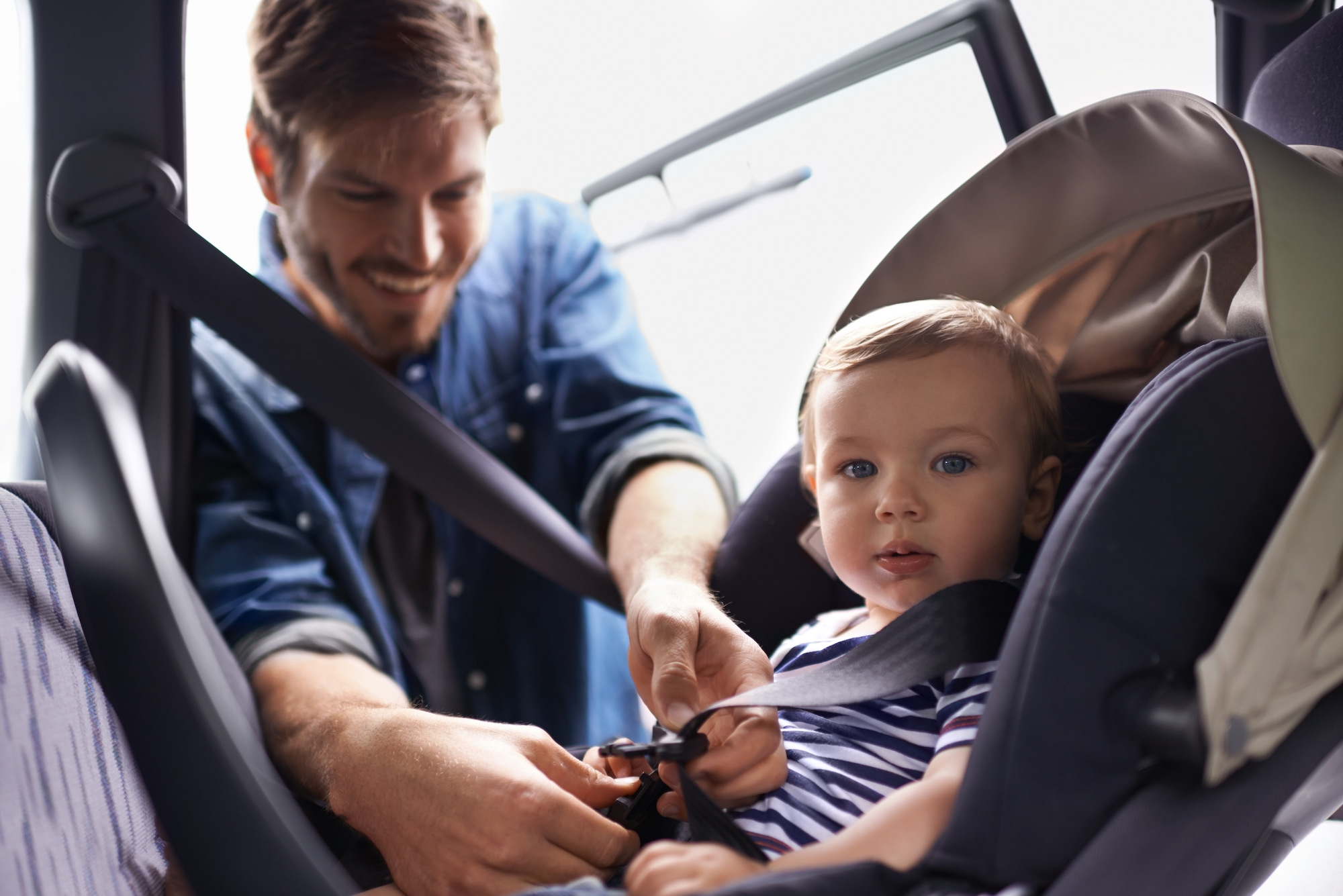
Car seats protect children. Having your child in the proper safety seat can make a huge difference. Jeff has represented families who have been in very bad wrecks. In one case, the entire front of the car was completely crushed. There was a child in a proper safety seat who had no injuries. This is not uncommon. Jeff sees fewer injuries to children in car seats, than to those children who don’t have to be in car seats based on their age or size, or to adults.
Selecting the Proper Car Seat for Your Child
It’s important that you use the proper child safety seat for your child. The Kentucky Transportation Cabinet’s website has guidelines to help you to select the proper car seat. According to those guidelines, a child must be kept in a rear-facing car seat a minimum of 1 year and to a weight of 20 pounds. The best practice is to keep the seat positioned that way until the child reaches 2 years of age and 30 pounds. At this point, the child safety seat can face forward.
A child less than 40” tall is required to be in a car seat. Children younger than 8 years of age and between 40”-57” must be seated in an approved booster seat. Children younger than 8, but taller than 57” do not have to be in a booster seat.
Properly Installing the Child’s Car Seat
If you’ve ever installed a child’s car seat, you know it can be challenging. Your local police department may offer clinics on installing a car seat or actually check to ensure it’s properly installed.
The standards on car seats improve over time. Rather than using one you’ve stored for a couple of years, it’s better to purchase a new child car seat to ensure it’s the safest model. The material, including either the structure or the fabric can fail, especially if the seat has been exposed to temperature changes, over an extended period of time.
If you’d like more information, read the National Highway Traffic Safety Administration’s page dealing with car seats and booster seats. Please consider sharing this link with family and friends.
Remember, if your child is going to ride in a car with another family member or friend, make sure that vehicle has a proper safety seat. If not, take time to transfer your seat and make sure it’s properly installed. Don’t assume the other person “will figure it out.” It’s not worth risking the safety of your child.
Don’t assume everything will be okay, because they’re just heading down the street, or a couple of streets over in the neighborhood. Many accidents occur extremely close to home. You and others might tend to be less observant, based on familiarity with the area. There’s also the fact that the 3-5 miles near your home are more frequently traveled by you. The risks of not properly securing your child far outweigh the few minutes it would take to ensure the seat is correctly installed and that your child is buckled in the right way. The consequences of not doing so, could be tragic.
Avoiding Texting while Driving
Another one of the safe driving tips Jeff discusses is the risks of distracted driving. Most often, this included avoiding texting while driving. Jeff comments on some fairly recent statistics on distracted driving. In 2022, 8% of fatal crashed that occurred were the result of some type of distracted driving. That 8% equated to 3,300 fatalities. At the same time, 12% of the collisions resulting in injuries involved a distracted driver. The 12% equated to nearly 300,000 people.
Unfortunately, texting while driving and other forms of distracted driving can also result in higher rates of pedestrian accidents and bicycle accidents.
Distracted and drowsy driving, especially on interstates and highways, can lead to very serious traffic accidents and, unfortunately, traffic fatalities. At highway speeds, the distance you travel in a just a few seconds is equal to the length of a couple of football fields. People fail to understand the inherent risk of not keeping your eyes on the road.
Western Kentucky has some incredible recreational areas, such as Land Between the Lakes, Eddie Creek, and other areas. After a long day on the water, you’re going to be fatigued. This doesn’t take into consideration whether alcohol was consumed. You reaction time and your alertness is going to be diminished. Consider letting someone else drive if you’re feeling tired. Take breaks to stretch or get some fresh air. Stop at a gas station and buy a soft drink or something help to improve your focus and concentration.
Parents, take time to remind your college students who may be driving to or from campus to ensure they are awake and alert. Make sure they’re wearing a seat belt. If they’ve been on the road for a long period of time, encourage them to take a short break. Encourage them to avoid unnecessary distractions, while they’re driving. It’s better to arrive a little later than anticipated, rather than to not arrive at all.
We hope you found this episode insightful and helpful.
Thank you for listening!
What Do Other Clients Think About Jeff?
We always encourage listeners to read the Google Reviews Jeff Roberts has received from many of his clients. A 5-Star rating and the comments are earned recognition and demonstrate Jeff’s commitment to his clients. As a solo attorney, he has more Google Reviews than some firms with multiple attorneys. Jeff shares the credit with his staff at the Roberts Law Office. Successfully representing injured clients is a team effort. It’s why Jeff likes to say his firm offers small town service with big city results.
Jeff Roberts Represents Injured Clients Throughout Kentucky
With offices located in Calloway County (Murray) and now in Christian County (Hopkinsville), Jeff has a history of representing personal injury clients, workers’ compensation clients and social security disability clients across the state. He’s represented clients from Paducah, Bowling Green, Louisville, Covington, Whitesville and many other Kentucky locations. He’s not just a Western Kentucky injury attorney.
Is It Time to Speak with an Attorney about Your Car Wreck Claim?
The office phone number is (270) 753-0053 or toll free at 800-844-5108. For more information, visit www.JeffRobertsLaw.com. This podcast is meant to provide information and is not legal advice. Jeff’s principal office is located at 509 Main Street, Murray, Kentucky. Co-host Jim Ray is a non-attorney spokesperson. This is an advertisement.