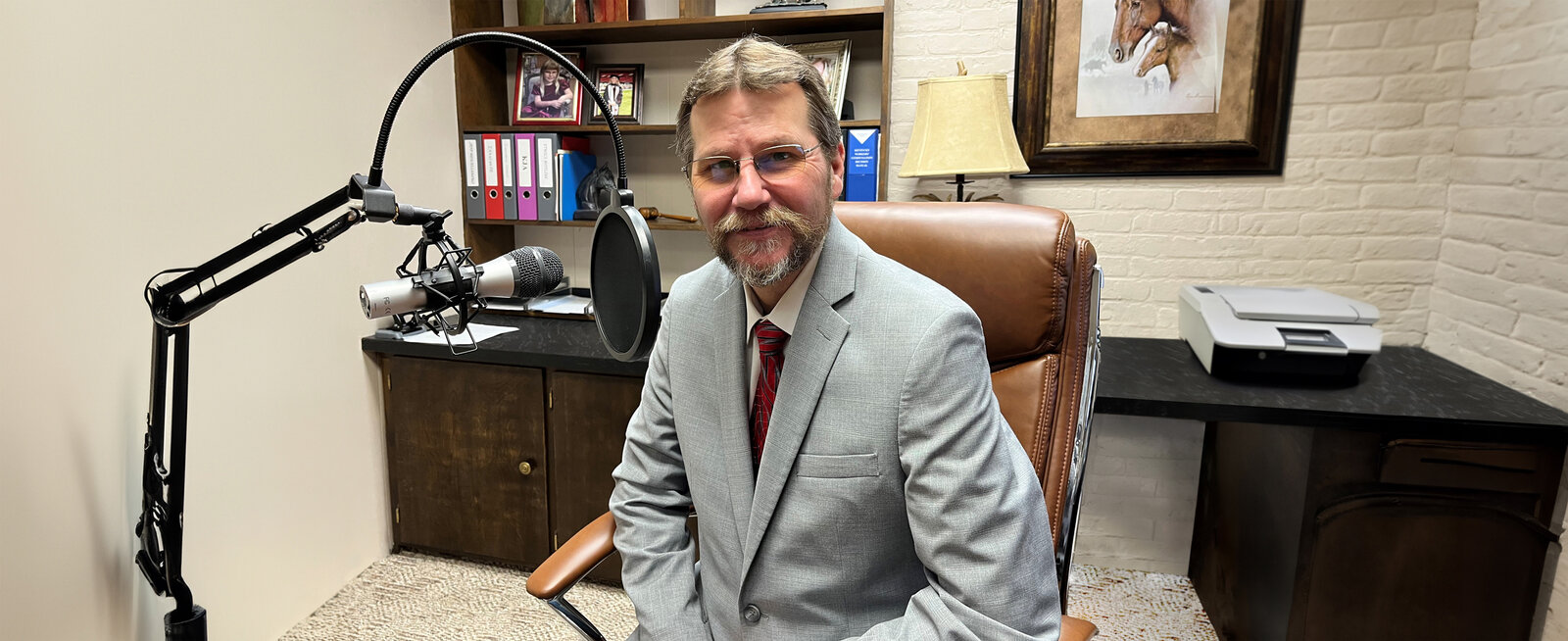

Episode 96: Calloway County attorney Jeff Roberts has handled car wreck cases for over 32 years. In today’s episode, he’ll explain an important issue regarding your accident claim. There’s a chance your settlement could be reduced, because Kentucky is a pure comparative fault state. This is why you should have an experienced attorney represent you.
What Does Pure Comparative Fault Mean?
This is a legal concept most non-lawyers don’t know exists. Taking a step back, there was another concept called “contributory fault.” This meant that if your actions contributed to the accident, you could not recover for injuries you may have received. In the early 1990s, courts began to accept the concept of comparative fault, in automobile accident cases.
Often, there are multiple causes or factors that ultimately result in a collision. It’s possible that one driver’s actions may have led to the other driver crashing into them. For instance, if the first driver was stopped in the road and the other driver rear-ends them, the first driver shares some degree of fault for the traffic accident. He/she should not have been stopped in the middle of the road. At the same time the second driver should have been paying attention and stopped or swerved to avoid the other car.
Kentucky is a pure comparative fault state. Therefore, a percentage of fault can be assigned to each driver involved in the collision. The driver would not be able to recover that percentage of their damages. If you are deemed to be 20% at-fault for the collision, your total damages can be reduced by 20%. Most of the time, a jury would make this decision regarding the allocation of fault.
Other states have different approaches. For instance, in some states, if you’re 50% or 51%, you may not be able to recover any of your damages. That’s not Kentucky’s approach. In Kentucky, even if you’re 90% at-fault, you can still recover 10% of your damages.
In Jeff’s opinion, our system makes more sense and seems to be pretty fair verses how other states may handle fault.
Jeff handles a lot of trucking accident cases. Obviously, the injuries to the people in the car would usually be much more severe than what the truck driver received. Pure comparative fault can help in this situation, even if the driver of the car was at least partially responsible. There would still be a way for the people in the car to recover some amount of money to cover medical expenses and other types of damage.
Fault Risks when Not Wearing a Seatbelt
Everyone in the car should be wearing a seatbelt. If you’re in an accident, not wearing one can affect your claim, even if you didn’t contribute to the collision. It’s possible for an insurance adjuster argue that the injuries you sustained were worse because you neglected to wear your seatbelt. Pure comparative fault would allow some percentage of fault to be attributed to you, thus reducing your recovery.
Comparative Fault Verses No-Fault in Kentucky
These two terms could be confusing, but they’re actually unrelated. Jeff has spoken with people who have heard that Kentucky is a no-fault state, so they incorrectly assume they can’t recover from the negligent driver. That’s incorrect.
Kentucky is considered a no-fault state, but this simply refers to the law specifying that the insurance for vehicle you are in at the time of the accident, will generally cover the first $10,000 in accident-related expenses. This applies to each person. To clarify, if you and your two children are in the car, each of you would basically have $10,000 in coverage.
A person can actually purchase more no-fault coverage that would increase the $10,000 coverage, although many don’t.
The advantage of no-fault coverage (also called Personal Injury Protection or “PIP) is that you don’t have to wait until the case is settled to recover damage to pay for your medical expenses, some lost wages and potentially other damages. Because it doesn’t matter which driver was at-fault, the funds can be either paid, or directed much quicker. It’s there to help you to be able to seek medical treatment, rather than having to put it off for financial reasons.
Filing a no-fault claim will also not affect your insurance rates. Remember, because it’s not based on fault, you’re not admitting to any portion of fault for the accident. The same would apply to your Under Insured Motorist (UIM) coverage.
Work with Your Attorney to Gather Important Evidence
After the accident, be sure to call 911 to request a law enforcement officer come to the scene of the accident. If someone is injured, you’ll also let them know in case an ambulance should be dispatched.
If you can get out of your car, use your phone to take photographs of all vehicles involved.
If the other driver admits something he/she did that caused the accident, make a note of it and communicate that to the officer. You want that statement documented in the police report.
Seek medical treatment, if needed. If you were wearing your seatbelt at the time of the collision, make sure you let the officer and healthcare professionals know. Again, you want to have that documented in the police report and/or medical records. The vehicle’s “black box” should indicate whether the seatbelt was in use, but it may not be recovered before the vehicle is destroyed.
If there are witnesses at the scene of the accident, try to get their names and contact information. They may be willing to simply record it on your phone, to make things easier. Remember, most police officers aren’t trained in accident reconstruction, so preserving statements from witnesses who were actually there at the time of the accident is extremely valuable.
Be truthful with the officer, but you can limit your comments to the basic facts. Lying about the car wreck could be considered insurance fraud. You don’t have to volunteer information. If you are unclear, it’s okay to admit you don’t know.
In a pure comparative fault situation, you want to do your best to establish the facts of what happened. This can keep you from being blamed, later in the process. Steps such as telling the police and doctors you were wearing your seatbelt can give your attorney a better set of facts to argue.
Who Decides the Division of Fault in a Car Wreck?
As Jeff has stated in previous episodes, most accident claims are settled before they go to court. Even so, who assigns the percentage of fault? At times, your attorney can reach a fair determination with the insurance adjuster during the negotiations.
There are some situations in which the percentage of fault isn’t necessarily relevant. Jeff explains that in a severe accident, the medical bills can be significant. Assume your damages are in the $250,000 range, but the driver only has a $100,000 insurance policy. Even if you’re 25% at-fault, you could still collect the policy limits of $100,000. The math shows 25% of $250,000 in damages is $62,500. Even if you accept the 25% portion, the remaining damages still exceed the $100,000 in coverage.
Jeff may be able to negotiate additional recovery from your Under Insured Motorist coverage.
If the case goes to trial, ultimately the jury decides the division of fault, in probably 99% of the cases.
We hope you found this episode insightful and helpful. Thank you for listening!
What Do Other Clients Think About Jeff?
We always encourage listeners to read the Google Reviews Jeff Roberts has received from many of his clients. A 5-Star rating and the comments are earned recognition and demonstrate Jeff’s commitment to his clients. As a solo attorney, he has more Google Reviews than some firms with multiple attorneys. Jeff shares the credit with his staff at the Roberts Law Office. Successfully representing injured clients is a team effort. It’s why Jeff likes to say his firm offers small town service with big city results.
Jeff Roberts Represents Injured Clients Throughout Kentucky
With offices located in Calloway County (Murray) and now in Christian County (Hopkinsville), Jeff has a history of representing personal injury clients, workers’ compensation clients and social security disability clients across the state. He’s represented clients from Paducah, Bowling Green, Louisville, Covington, Whitesville and many other Kentucky locations. He’s not just a Western Kentucky injury attorney.
Is It Time to Speak with an Attorney about Your Car Wreck Case?
The office phone number is (270) 753-0053 or toll free at 800-844-5108. For more information, visit www.JeffRobertsLaw.com. This podcast is meant to provide information and is not legal advice. Jeff’s principal office is located at 509 Main Street, Murray, Kentucky. Co-host Jim Ray is a non-attorney spokesperson. This is an advertisement.