
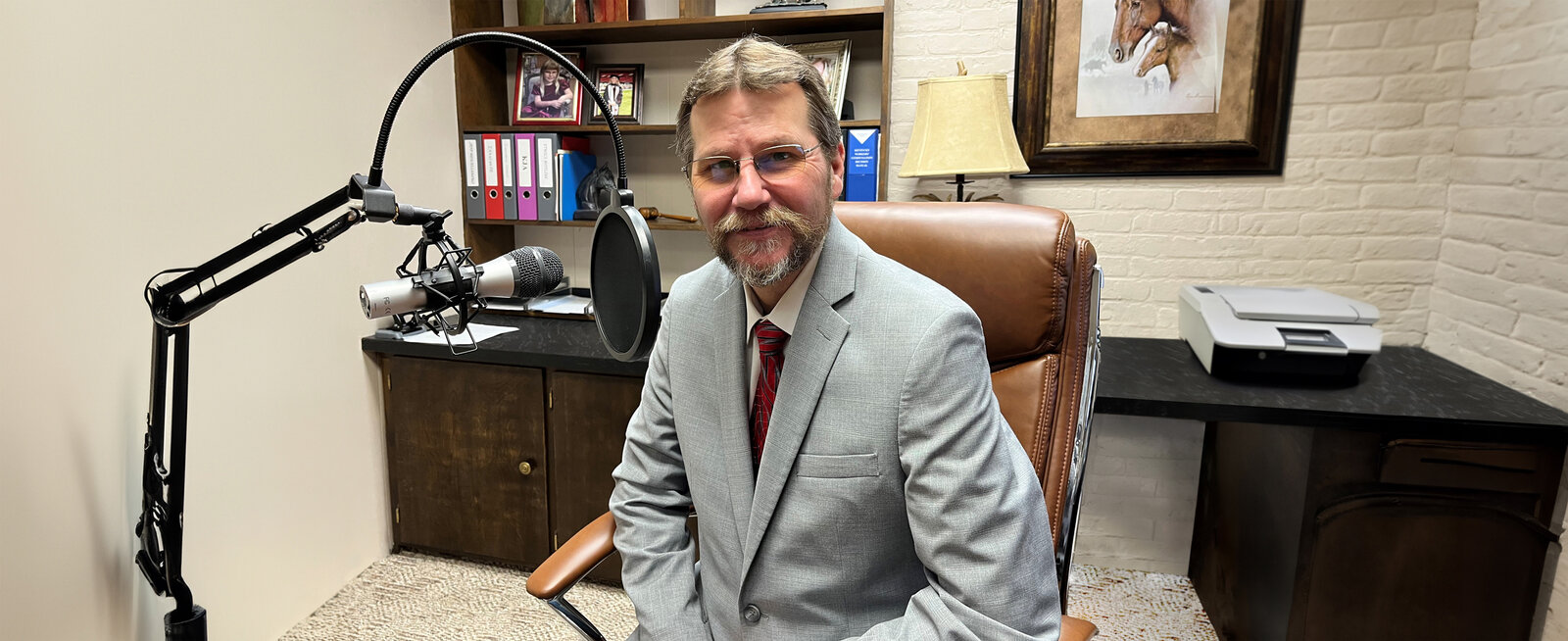
Episode 114: Calloway County injury attorney Jeff Roberts discusses helping people who were injured in a rear-end collision. Jeff has 33 years of experience handling automobile accident cases. He comments that rear-end collisions and T-bone collisions are the two most common types of accidents he sees. When someone else’s negligence results in a car wreck and possible injuries, you should speak with an experienced attorney who can provide trusted guidance.
Common Myth – It’s Always the Fault of the Person Who Rear-ends the other Vehicle
Many people assume the law protects you, if you’ve been rear-ended, but that’s not always the case. While it often is the fault of the person who collides with the car in front of them, there are exceptions to the rule. Assume you were stopped at an intersection and the car behind you crashes into your car. This may be fairly cut and dry.
However, Kentucky is a pure comparative fault state, and that can come into play in a rear-end collision. If you were stopped at an intersection, waiting to make a lefthand turn, but didn’t have your blinker on, you could bear some of the responsibility for the car wreck. The same could apply if your brake lights weren’t working. There’s also the situation in which the lead car suddenly stops for no reason and is subsequently hit by the car behind it.
In cases in which there is some comparative negligence on behalf of the lead car, the settlement or jury can place a percentage of the blame on that driver. The result is that their recovery will be reduced by that percentage, because they were partially responsible for the collision. Jeff explains that not every state uses pure comparative fault.
In some states, if you are proven to be 50+% at fault, you cannot recover any amount for your damages. Imagine having $1 million in damages (with medical expenses) and not being able to recover the 49% of the damage were attributed to the other driver.
Common Injuries from Rear-end Collisions
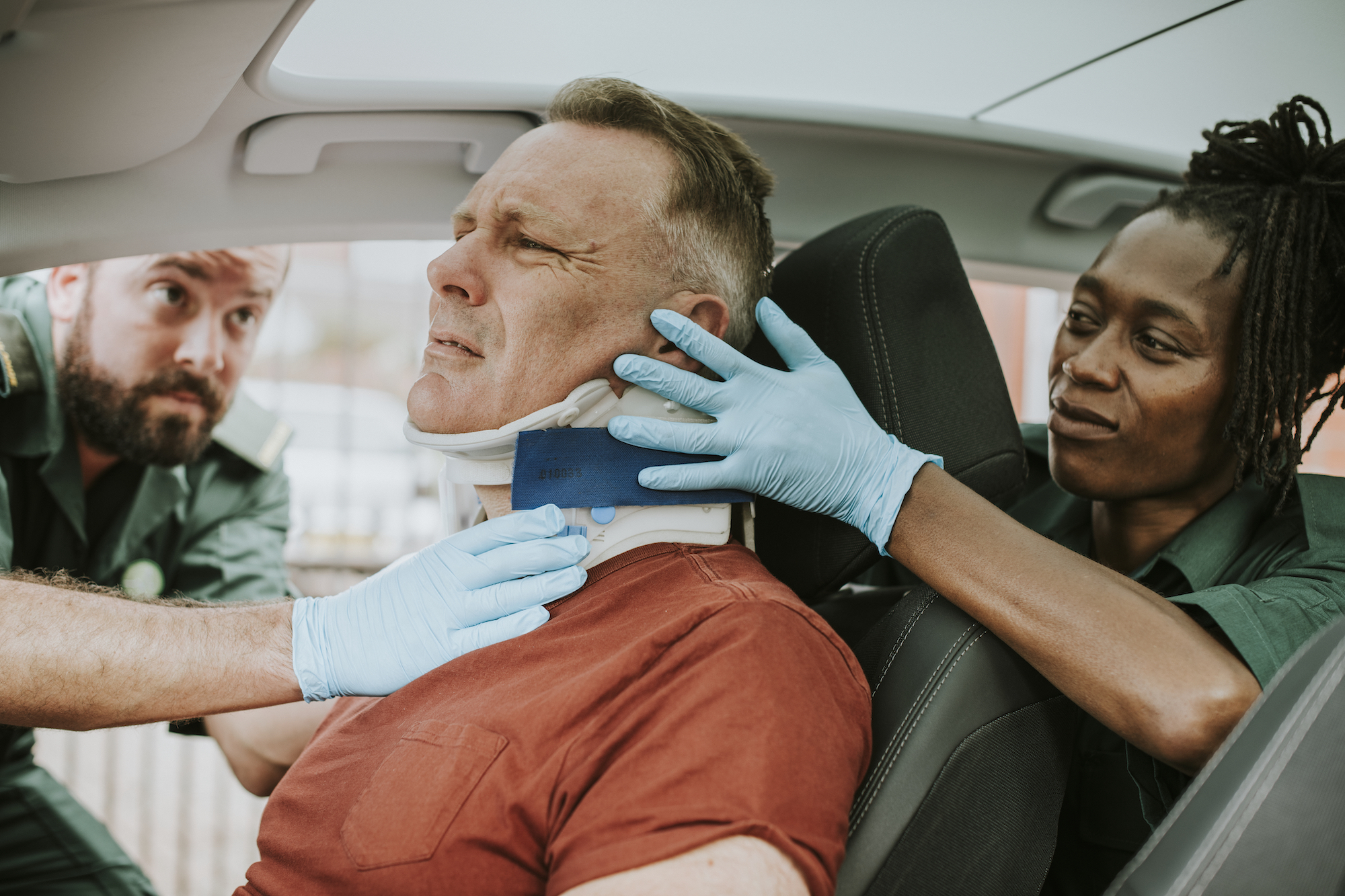
The most common injury Jeff sees is what’s commonly called whiplash. This is a neck strain or sprain. While your seatbelt keeps you in place, your head will still whip forward and backwards. This sudden, violent movement causes microscopic tears in the muscles of the neck. The muscles can be sprained and scar tissue can develop. This results in ongoing pain and discomfort for the victim. You may have decreased motion. Some of the results can be permanent. These are typically referred to a soft-tissue injuries.
A soft-tissue injury normally involves the muscles and tendons, rather than the bones themselves. The challenge with a soft-tissue injury is that an x-ray or MRI won’t show it. Common signs are a decreased range of motion, muscle spasms, tenderness where the pain is located, etc. The physical exam can help to identify the injury.
In situations in which the impact was more severe, you could sustain a herniated disc in your neck. If you weren’t looking straight ahead at the time of the impact, this increases your chances of a more severe neck injury.
The wearing of seatbelts is mandatory in Kentucky. If you’re not wearing a seatbelt, you can experience a low-back injury. The more forceful the impact, the greater the potential that you will sustain a low-back injury. However, the seatbelt can protect you from other injuries. In fact, not wearing a seatbelt can result in someone being at least partly negligent for the injuries they may have sustained in the wreck. Those injuries might have been avoided or minimized, had they been wearing their seatbelt.
If the driver tenses up, stands on the brake or make some other subconscious reaction in anticipation of the collision, there will often be injuries to the knee, broken bones in lower leg and ankles if you’ve been injured in a rear-end collision.
Advice Regarding Seatbelts AFTER the Collision
Jeff advises people to make sure they tell the first responder that you unhooked their seatbelt, after the collision, assuming that is the honest truth. Tell the police, EMS and even the hospital staff. You want to make sure it’s documented that you were wearing it, at the time of the wreck.
Many cars have an event data recorder (EDR), also called a “black box” that would indicate you were wearing the seatbelt, but evidence can get damaged, lost or destroyed. Getting the download from the EDR can cost several thousand dollars, so it may not always be a step taken. Again, this is why you want to communicate that you were wearing your seatbelt.
Airbags Don’t Prevent All Injuries
The airbag will help to prevent or decrease certain injuries. However, it’s important to remember some injuries will still occur. Jeff was in a wreck and still sustained a neck injury, even while wearing his seatbelt. The airbag itself will deploy with a lot of force, as well. This can also cause minor injuries.
Head Trauma and Brain Injury from a Rear-End Collision
You don’t have to hit your head to sustain a brain injury. A concussion is a common injury in a rear-end collision. The brain is a free-floating organ inside the skull. When the head is violently forced forward or backward, the brain will collide with the interior of the skull. This often results in a concussion or other brain injury. Some of the nerve structures can also be severed.
You don’t necessarily have to have an open wound for the brain injury to occur. A closed-head injury means there is damage inside the skull. In fact, some of the more severe injuries Jeff’s seen didn’t involve a laceration to the head. These were closed-head injuries.
Brain injuries can also go unnoticed by the person who was injured. A key sign is a sudden change in temperament or personality. An increase in mood swings, often toward anger, can be a result of a brain trauma. This is one of the reasons Jeff often asks the spouse or other family members if they’ve noticed a change, since the accident. The victim might be unaware the change has taken place. It’s important for the family member to speak with the doctor about the changes. The doctor may need to refer the patient to a neurologist for testing and treatment. A neuropsychologist may also need to be involved in the assessment when you’ve been injured in a rear-end collision.
Understanding Longer-Term Medical Treatment
It’s important that your attorney has an understanding of the type and extent of the injuries. Many, especially traumatic brain injuries, will require extensive rehabilitation and other types of ongoing treatment. These activities will result in additional medical expenses. Those expenses need to be accounted for in the negotiations and the ultimate settlement. It takes time to fully evaluate the extent of the injuries and what type of treatment will need to be done. Jeff may consult with a variety of experts, such as a life-care planner, who can define and evaluate the lifetime treatment plan and the related costs.
This is another reason Jeff advises clients not to settle the claim too quickly. While financial issues can place pressure on the individual and his/her family, there’s a definite possibility the full extent of the medical expense haven’t been determined. The injuries may require a series of surgeries and rehabilitation. Modifications to the home may be necessary. Adaptations to vehicles may be required. Jeff helps his clients to fully appreciate the extend of the damages. If a case is settled before this determination is made, there isn’t a way to go back to argue for additional damages.
We hope you found this episode insightful and helpful.
Thank you for listening!
What Do Other Clients Think About Jeff?
We always encourage listeners to read the Google Reviews Jeff Roberts has received from many of his clients. A 5-Star rating and the comments are earned recognition and demonstrate Jeff’s commitment to his clients. As a solo attorney, he has more Google Reviews than some firms with multiple attorneys. Jeff shares the credit with his staff at the Roberts Law Office. Successfully representing injured clients is a team effort. It’s why Jeff likes to say his firm offers small town service with big city results.
Jeff Roberts Represents Injured Clients Throughout Kentucky
With offices located in Calloway County (Murray) and now in Christian County (Hopkinsville), Jeff has a history of representing personal injury clients, workers’ compensation clients and social security disability clients across the state. He’s represented clients from Paducah, Bowling Green, Louisville, Covington, Whitesville and many other Kentucky locations. He’s not just a Western Kentucky injury attorney.
Is It Time to Speak with an Attorney about Your Rear-End Collision Claim?
The office phone number is (270) 753-0053 or toll free at 800-844-5108. For more information, visit www.JeffRobertsLaw.com. This podcast is meant to provide information and is not legal advice. Jeff’s principal office is located at 509 Main Street, Murray, Kentucky. Co-host Jim Ray is a non-attorney spokesperson. This is an advertisement.